It might seem farfetched to characterize a metric as sexy, but by the time you are done reading this article you'll be more than attracted to the metric and will mentally associate all sorts of possibilities between you and bounce rate!
It is quite likely that the biggest challenge for you is that you are spending tons of time, energy, and budget on Web marketing efforts, yet conversion rates (or ROI) are stuck in the 2-4% range.
You are trying really hard to figure out how to improve the performance, but you are stymied by the fact that there is ton of data and you have no idea where to start.
Ms. Bounce Rate to the rescue.
Bounce rate is a beautiful way to measure the quality of traffic coming to your Web site. It is almost instantly accessible in any Web analytics tool. It is easy to understand and hard to misunderstand, and it can be applied to any of your efforts.
So what is this mysterious metric? In a nutshell, bounce rate measures the percentage of people who come to your Web site—and leave "instantly."
Thought about from a customer perspective, rather than "I came, I saw, I conquered," the action is "I came, I saw, Yuck, I am out of here."
Your marketing efforts should yield more customers who are able to conquer (accomplish the task they are there to accomplish) and fewer who say yuck and leave.
Bounce rate measures quality of traffic you are acquiring, and if it is the right traffic then it helps you hone in on where/how your Web site is failing your Web site visitors.
It is usually measured in two ways:
- The percentage of Web site visitors who see just one page on your site.
- The percentage of Web site visitors who stay on the site for a small amount of time (usually five seconds or less).
Either definition is fine; each has its own nuance. Check what your tool's definition is.
So how can you use it?
1. Measure the bounce rate of your Web site
This will help you understand what percent of your Web site traffic is actually engaging with your site (i.e. you don't have a chance of success with all your site traffic!).
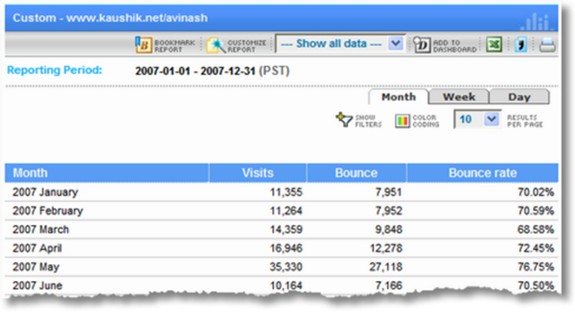
This IndexTools report shows that approximately 70% of the site traffic is bouncing. This 70% won't even give you five seconds, or see more than one page. You can't even start to impress them with your goodness.
Action: Here's how to understand better why your conversion rate is so low: If you make changes over the last x amount of time, then watching a bounce-rate trend is a sure way to know whether the changes you make are for the better.
2. Measure the bounce rate for your traffic sources
Your goal is to figure out whether some sources of traffic are sending you particularly terrible traffic versus other sources. In your Web analytics tool, simply go to the referring URLs/sites report and look at those numbers.
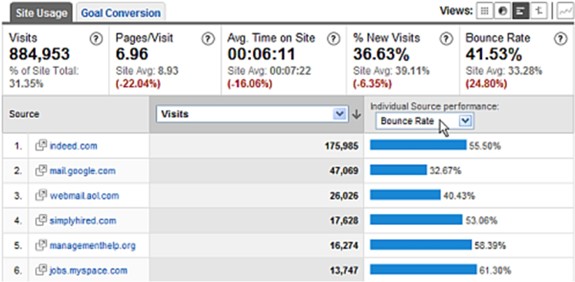
For this site, Google Analytics illustrates that both myspace.com and simplyhired.com are not sending great traffic, while the direct marketing campaigns (Nos. 2 and 3) seem to be doing much better.
Action: Do you need to revisit relationships with sites that are not sending you high quality traffic? What is the call to action that is causing people to come to your site and bounce? Are your email, affiliate, other marketing campaigns yielding low bounce rates? You get the idea...
3. Measure the bounce rate of your search keyword
Search engines are king and are probably sending you a large chunk of your traffic. Find out the quality of traffic coming from the search engines. In addition to looking at aggregate levels, also look at each key phrase.
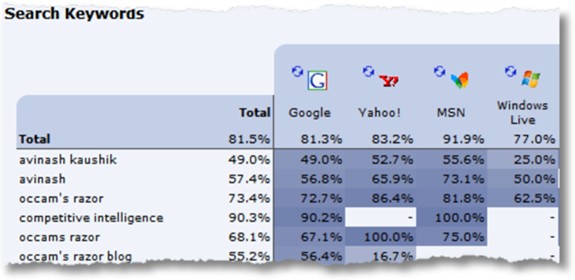
In this ClickTracks report, notice that each keyword/phrase performs differently, and it also differs by search engine. Sweet actionable information.
Action: When you create SEO and SEM campaigns, ensure that your team has this data. In this case, either you have nothing to do with competitive intelligence (hence 90% bounce rate) or that traffic is landing on the wrong pages. Also, it is easy to take a dump of top keywords and bid on them with PPC campaigns; a table such as the above will ensure that you don't bid on the wrong ones.
4. Measure bounce rate of your AdWords, AdCenter, YSM (PPC) campaigns
In my humble experience, this is one piece of analysis most agencies and companies overlook. Sure we measure conversion and ROI and revenue, but are you measuring bounce rate for your pay-per-click (PPC) campaigns? Remember that you can only convert if people are staying for more than five seconds on your Web site!
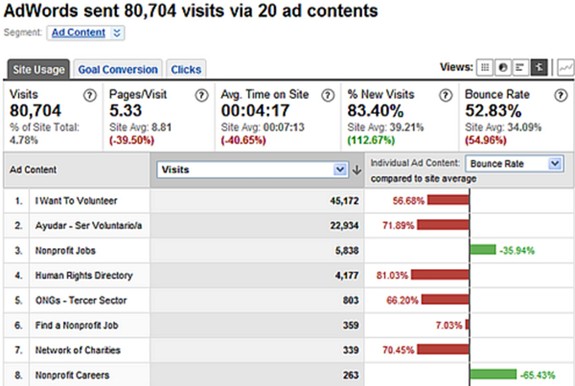
This screenshot from Google Analytics shows the bounce rate of traffic on each keyword compared with site average: very cool view. Sadly, most traffic for this time period is performing worse than site average (so you could be sending money down the drain).
Action: First, stop bidding on those keywords; then, do a deeper analysis of how good your landing pages are, and check your other campaign attributes (maybe your campaign for refrigerators is being targeted to people only in the great state of Alaska!).
5. Measure bounce rate of your top trafficked pages
Now it is entirely possible that your efforts are stellar (as they usually are), but it is your Web site that is letting you down. Here is what to do to make your case...
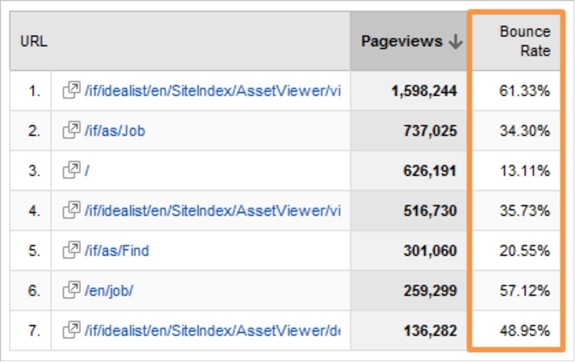
What pages are bouncing traffic like a perfectly formed elastic material, and which are great at welcoming traffic with open arms into your Web site? Pull up the above report in your Web analytics tool and find out.
Action: Check to see if the right calls to action are on the page. Is the content optimally organized? If the above pages are your campaign landing pages (for direct marketing or paid search campaigns), then consider whether they are delivering on the promise of the email piece you had sent out or the search keyword. Answer these questions, and consider multivariate testing to improve page performance.
* * *
So would you agree this is an awesome metric? It won't have all the answers for you, but it will help you focus very quickly on what's important, show where you are wasting money, and what content on your site needs revisiting.
As a benchmark from my own personal experience over the years, it is hard to get a bounce rate under 20%. Anything over 35% is a cause for concern, and anything above 50% is worrying.
Mr./Ms. Marketer, meet Ms. Sexy Metric.