The current economic environment makes marketing professionals' ability to produce desired results—as efficiently as possible—top-of-mind. Knowing what to improve and by how much is vital to establishing realistic performance targets and metrics.
This two-part article discusses how to use benchmarking to assess your organization's performance and to understand what changes to make. Part 1 defined benchmarking and explored its value.
This second and final part identifies marketing capabilities and process that can be benchmarked and outlines the five phases associated with a successful benchmarking initiative.
Marketing Processes and Capabilities to Be Benchmarked
Which marketing processes and capabilities should your company benchmark? Research by Doug Vorhies, Neil Morgan, and others has revealed eight marketing capabilities that can be benchmarked:
- Product development (the processes by which a company develops and manages product and service offerings)
- Pricing (the ability to extract optimal revenue from your customers)
- Channel management (the organization's ability to establish and maintain channels of distribution that effectively and efficiently deliver value to the end-customer)
- Marketing communications (the organization's ability to manage customer value perceptions)
- Market information management (the processes that organizations use to learn about their markets and use market information)
- Marketing planning (the organization's ability to create optimal marketing strategies)
- Marketing implementation (the processes which strategies are deployed)
Various studies have shown that companies that excel at these marketing capabilities significantly outperform those that are below the benchmark in terms of customer satisfaction, return on assets, profitability, and market effectiveness.
Therefore, companies and organizations wishing to improve in these areas should consider benchmarking their marketing capabilities by searching among competitors and peers in other industries to identify the drivers of superior performance.
Undertaking Benchmarking
Four basic stages or phases are associated with benchmarking: measuring your own performance, planning, deployment, gap analysis, and action.
Phase 1: Performance Measurement
To effectively use a benchmark as a way of closing a performance gap, you will need to know your current performance for the marketing process or capability. This phase helps you determine you current performance.
Phase 2: Planning
This is the phase where you set expectations, plan the project, organize the team, and contact potential partners. During this phase you will want to define the issues or critical success factors that, if addressed, will have the greatest potential for improvement and impact.
During this stage, it is important that it be very clear how improving one of the marketing capabilities will add value to the company.
To execute the plan, you will need to fill three major roles: the process owner (whoever owns the process for that marketing capability will need to be a part of the benchmarking study), the people who will be most affected by the process, and the person responsible for managing the project.
That team will be responsible for identifying, contacting, qualifying, and working with potential benchmarking partners. The team should look for partners who...
- Had a similar problem with one or more of the marketing capabilities at one time
- Came up with a specific solution to this problem
- Has a solution that you can adopt or adapt
- Saw tangible, value adding results they can share as a result of the solution.
- Possess those characteristics that make their practices adaptable to your company
Phase 3. Study deployment
In this phase you decide specifically which aspect of the marketing capability you want to study and how the data will be collected, organized, and analyzed. In this phase, the team can complete a table similar to the following one:
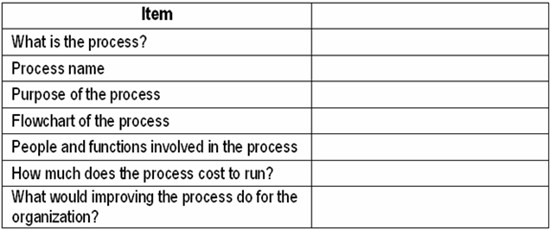
In this phase, you will construct the questions for the study. Because the benchmark company may be different for each capability, you may need to either do more than one study or explore bringing in various companies from within and outside of your industry so all of the participants can benefit from having information on all various processes. Other companies may thus have a reason to initially participate: They gain insight into a benchmark for an area where they want to improve in exchange for serving as the benchmark on another process.
So what kind of processes do you want to assess? Each marketing capability has its own, which is why the table is so important. Whatever process you decide to benchmark, you want to benchmark it, the performance drivers, and the cost and time associated with each. For example:
- In the case of pricing, you may want to assess how quickly the benchmark company can change pricing to respond to market needs, or their knowledge of competitors' pricing tactics, and the cost and time associated with these.
- When it comes to product development, you may want to benchmark processes associated with testing or launching new products/services.
- For channel management, it may be worthwhile to benchmark the strength of relationship with distributors or the benchmark company's ability to attract and retain the best distributors.
- For marketing communication, possible processes to benchmark are skills, reputation management, sales training, and program development and execution, along with the cost and time associated with these.
- In the area of marketing information management, it can be a good idea to benchmark gathering customer and competitive information, tracking customer needs and wants, using market research skills to develop effective marketing programs, and processes for analyzing market information.
- When it comes to marketing planning, planning skills, the ability to effectively segment and target the market, processes ,and costs for developing marketing strategies make good benchmarking targets.
- Benchmarking marketing implementation may require looking at how marketing resources are allocated and comparing the results produced by various program.
As you deploy the study, be sure you understand the results that the benchmark company has realized by improving the process in terms of customer satisfaction, delivering value to customers, retaining valued customers, market share growth relative to competitors, sales revenue growth, acquiring new customers, increasing sales to existing customers, and reaching financial goals.
Phase 4. Gap Analysis
This phase is focused on locating, understanding, and interpreting the gaps that emerge from the data—compared with your performance for that process or capability. That is, you evaluate your performance against the study results, and determine the delta.
Phase 5: Actionable recommendations
Once you understand the gap, what performance could be, and the underlying drivers of how the benchmark is achieved, create a plan of action that will help your organization toward decreasing the gap and achieving the results.
Conclusion
If you are looking for an objective way of using outside data for comparison to improve your marketing processes, practices, systems, and metrics, benchmarking may be an ideal approach because it provides a point of reference for what your results could be, alternative feasible ways to make improvements, and insights into how to close performance gaps.
It can be a cost-effective method for making dramatic improvements to your marketing processes that will contribute to the bottom line.
To conduct your own study is an investment and probably will require anywhere from $50,000 to $60,000 (American Productivity & Quality Center and Saratoga Institute). If you are member of an association or have a service with a market analyst, you may be able to participate in a benchmarking study as part of your existing investment or use their data as a beginning benchmark.