Salespeople's lips moving—that's how deals get done.
Everyone talks about the importance of listening during the sales cycle; but, let's face it, no one buys from a mute salesperson. You eventually have to talk, and when you do, know this: The entire deal is riding on what you have to say, even more than what you have to sell.
This article will discuss the three deadly sins of sales messaging and how you can successfully avoid them in order to create more demand and win more business.
Sin No. 1: Blabbermouth
You can still say too much—because you know so much and you assume your customer wants to know as much as you do. Also, your product marketing team wrongly believes the buyer needs to know a lot more to make a decision. So with the best of misguided intentions, they jam-pack presentations and sales tools with every feature and function your product has to offer.
In reality, the more information you insist on giving your prospects, the worse you can make it for yourself. A deluge of detail, especially too soon, can have detrimental effects:
- You might create confusion, which leads to indecision because the customer is overwhelmed with the capabilities you are describing.
- You also run the risk of introducing too many features that are similar to those of competitors, which may cause prospects to see you as the same as everyone else.
- Worse yet, you may open up conversations in areas that may highlight competitive weaknesses, which will put you in a defensive position.
Sin No. 2: Self-focused
Your prospects can probably predict the first six slides in your presentation deck. You will tell them all about you and your company and why your products are best. You will also include the obligatory map of the world with your locations; the entire range of the products and services you provide; and the logo slide showing all of your clients (the same slide every one of your competitors opens with).
Customers live in their story and look at things from their point of view. They don't want to hear why you or your solution is the best; they want to know what you've uncovered from your customers, what you've learned in the market, what issues, problems, obligations, threats, or potential missed opportunities are coming around the corner that may put their objectives at risk.
Sin No. 3: Vanilla Pudding
One of the biggest complaints I hear from decision-makers is that most salespeople fail to clearly tell what's different about you. Since so many offerings are very similar, your audience is just looking for the one or two really relevant points that they can tie back to very important needs in order to make a decision.
Brain research shows that humans need to see contrast to make decisions. In the absence of contrast, the brain will force it. In fact, the tool most buyers use to create contrast is price. That's why we say pricing conversations are not typically budget-related; instead, they are the result of a lack of contrast. You haven't delivered a distinct point of view that helps create a buying vision and a reason to choose you. Instead, you've fallen into a bake-off where everyone is presumed to be exactly the same.
Repent and Sin No More
Here's a simple device for making sure that the story you are telling will avoid those three deadly sins. We call it the value wedge—the area in black in the following diagram that overlaps with your world, your prospect's world, and your competitor's world.
You want to focus on that area because it will help you identify what you can do for the customer that is different from what competitors can do—and how that is relevant to something the prospect does or should care about solving. Your best story lives there.
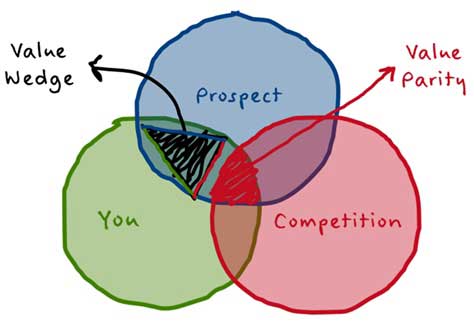
To find your unique value wedge to build your sales messages around, you must make sure that it meets the following three criteria:
- It's important to your prospect. Prospects live in their own world with problems, challenges, and issues that are emerging to create real risk and negative business impact. Your solution should be able to help resolve those problems, challenges, and issues—as well as those that prospects might not even realize they have.
- It's unique to you. Highlight the distinct strengths of your solution: In what way do they clearly outperform the current approach or competitive alternatives in fixing the prospect's challenges and risks?
- It's provable and defensible. Make sure that you can support and validate your value claims and solution strengths with credible evidence, and then clearly demonstrate how you can help prospects achieve the desired outcome and deliver measurable value.
The value wedge specifically helps you avoid each of the three deadly sins because...
- It's a wedge—not the whole pie. You won't be a blabbermouth telling your prospect too much. You'll focus the discussion on just what matters.
- It's about their story, first. You won't be self-focused, expecting prospects to care about your story. Instead, you'll be talking about the issues and trends causing concern for them and making their status quo unsafe.
- It's distinctly differentiated. You won't be vanilla and sound like everyone else. Rather, you'll be zeroing in on their issues and how your company specifically addresses those problems with unique or capabilities or ones that offer an advantage.
Successful sales conversations require you to uncover and present your value wedge. Prospects want to hear your distinct point of view on the potential challenges, threats, obligations, or opportunities that put their objectives at risk. And, to reach a decision, they want to clearly see a difference between what you offer and both their status quo and the competitive alternatives.
With the value wedge, that decision that will clearly favor you.