Well that didn't take long. In just a couple of years, we content marketers have done a heck of a job painting ourselves into a corner. Several corners, actually.
Our penchant for snappy axioms—most of them a derivative of "set content free"—has put content marketing on a collision course with otherwise sensible business objectives.
When I ran content strategy at a large marketing technology vendor, I was a purist. I felt that content should never be "locked" behind a form, that credibility demanded the brand's logo be "zeroed out," and that embedding even the subtlest sales message was a cardinal sin.
I was a purist because I could afford to be. Because of my employer's size, momentum, and diversity of marketing programs, we didn't have to force readers to complete a form to download an e-book or video. We didn't examine each content expense in the same way a small or early-stage company must. The luxury of time granted us the freedom to trust that those who valued our content would be more likely to buy from us when they were good and ready.
At an early startup, however, time and money reign supreme. Its marketers must find ways for all content—even creative assets such as infographics—to generate business, not just buzz. Every investment must advance the company.

So when I joined a mobile technology startup called Kinvey as VP of marketing, I quickly realized that I had been perpetuating a series of false choices. The content marketer in me had been at odds with the lead marketer in me.
I now hope to set the record straight, using as an example Kinvey's latest infographic, "How Long Does it Take to Build an iOS or Android App?"
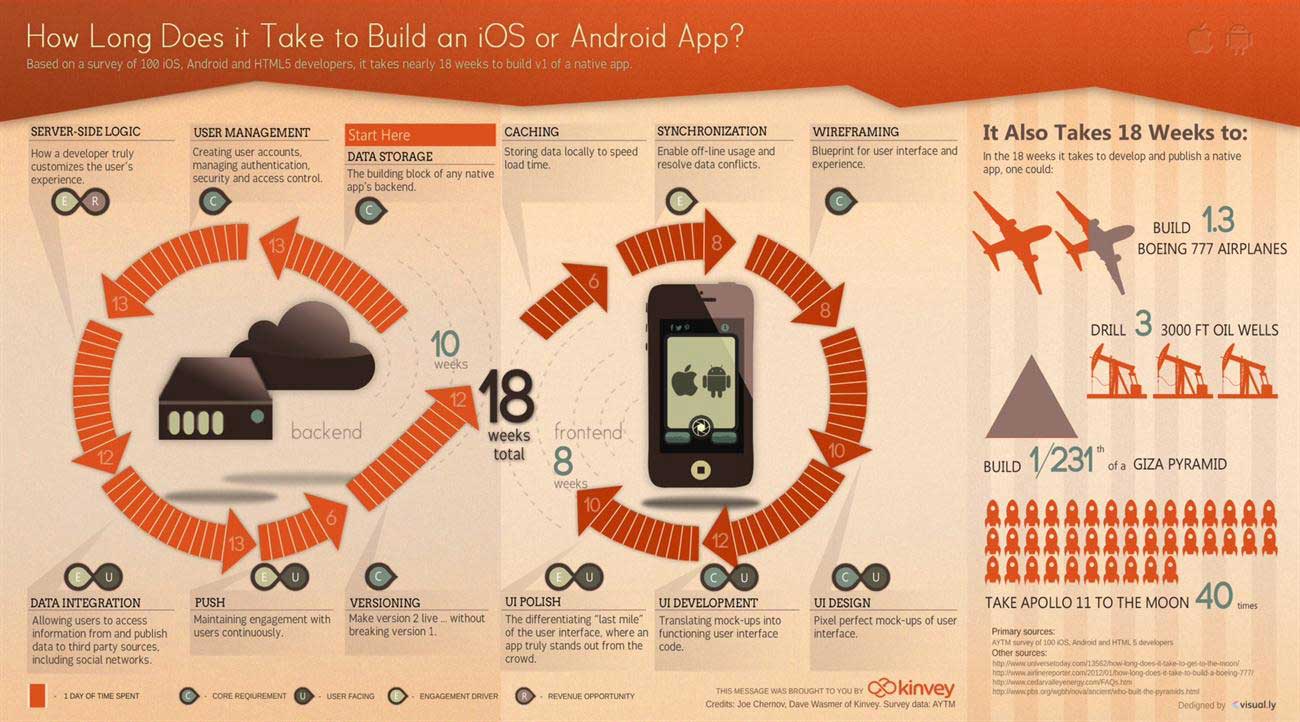
On the surface, it's a fairly straightforward infographic: a reasonably pretty picture, just confusing enough to force you to spend a few extra moments with it; a few surprising data points to provoke sharing; and lots of citations to reduce the risk of being flamed.
But, for me, what makes this infographic different is what it doesn't contain: false choices.
False Choice One: Large logos are bad for credibility; small logos are bad for branding. Pick your poison.
For top-of-funnel content, I still believe the size of one's logo is inversely proportional to the credibility of the content. That's why the Kinvey logo is among the smallest images in the graphic—so small, in fact, that it would be easy to miss.
But a logo is just one expression of branding, and the company's fuller branding can be felt throughout. An infinity symbol (the cornerstone of Kinvey's logo) serves as the central design element for the entire graphic. Smaller infinity symbols are sprinkled throughout the image, reinforcing the central theme. And the title section mimics the hero unit on the Kinvey website.
In other words, though the logo is small, the branding is pervasive.
False Choice Two: Content can either help or sell. It can't do both.
Kinvey helps mobile application developers cut in half the time it takes to build an app by providing them with an entire "app backend" (basically the app's technical "plumbing") in the cloud. As a start-up we are not in a position to churn out an infographic a week, so picking the right topic was critical.
We could have gone the "helpful" route and created something like "How to get approved by the AppStore," which, though it might have spread, wouldn't advance our corporate message. Alternatively, we could have selected a more sales-oriented theme that centered on our value proposition, but that would have a very limited appeal.
Instead, we compromised by creating an infographic that helped our audience anticipate how long it will take to build each aspect of their future app, and tacitly sold Kinvey by implying that we can help reduce the time investment.
False Choice Three: "With a form" and "without a form" are your only distribution options.
Obviously, nobody should put an infographic behind a form. Infographics are designed to spread organically, and a form naturally impedes that objective. Yet we can't afford to invest in content purely for brand awareness. We need to attract developers to try our platform.
Accordingly, we solicited input from companies with a complementary value proposition... throughout the development of the infographic—so that they would be intellectually and emotionally "bought in" to the finished product. Then we equipped each of these organizations with the graphic and a landing page on our joint value proposition.
These partners are now sending the infographic to their developer community, complete with a link to the custom landing page where developers can sign up for Kinvey. It's like putting the ATM next to the cash register.
* * *
Those three challenges aren't the only ones content marketers face, nor are Kinvey's tactics the only ways to overcome them. In the end, success often comes down to identifying traps you have inadvertently set for yourself, and finding a way around them.
What false choices do you find yourself making in your content marketing program?







![Mobile Minute [Video]: Are Smart Watches a Smart Move?](http://i.marketingprofs.com/assets/images/articles/lg/mobile-minute-lg.jpg)

Rate this
Overall rating
-
-
-
-
-
2 rating(s)Add a Comment
Comments
Joe- great read!. I am keen to know how you measure the effectiveness of content . What metrics do you use?
Purnima -- Kinvey has only been doing this form of marketing for a few months now. But we look at sign-ups (both content offer sign-ups and trial sign-ups), cost per acquisition, and as time goes on, the "quality" (how quickly they progress to a paid customer) per content asset and channel. (Additionally we track "buzz" metrics and SEO very closely.)
Nice share, Joe. The last point (custom landing pages for 'contributors') is a sweet play. PS - can't wait for Kinvey's How to Get Approved by the AppStore...
"Then we equipped each of these organizations with the graphic and a landing page on our joint value proposition."
Can you provide a link to any of these landing pages?
Leon - http://www.kinvey.com/phonegap
Joe- I loved the inverse relationship between logo size and credibility. The infographic you provided is a valuable resource for the mobile application industry and the logo is small- so your hypothesis looks true from here.
- @MrRyanConnors
Thanks, Joe. But not clear on how the infographic fits into this lead generation sequence. Don't see it on the landing page. Did they click on the infographic to come to this landing page?
Leon -- the idea is to equip partners with a content asset that serves as an excuse for them to email their subscribers (e.g., an email that says, "Check out this infographic by our partner! If you want to see how together we can cut time in your app development, learn more about our integration here: [landing page].")
Good read Joe. Visibility on content marketing could be a challenge also. If everyone commits to content marketing how do you get the content you create to be visible. Ensure you factor this into some of your decision making. Joe Wozny, Author of The Digital Dollar, Sustainable Strategies for Online Success
Joe - I like the email copy. Ties together the infographic and landing page very nicely. Thanks for the clarification.
Couldn't agree more, Joe. As marketers, we tend to gravitate in the direction we see results. As an agency especially, this can be very dangerous. We can apply the same strategies across two different clients and get opposite results. We're much more open-minded to strategies than we used to be. And we look at infographics as an example of what they learned that may help us, but not as a rulebook for our own strategies.
In my opinion, most of your content should be about helping your target audience do/learn something. I don't think there is anything wrong with adding a touch of promotion in there (every now and then anyway) but it can't scream sales.
Great article, Joe! I've heard you urge marketers to remove all forms on content before. As a small, B2B software vendor, we're struggling to find the appropriate line. Any thoughts on including forms for written content (articles, ebooks, etc.) in this type of scenario?
Heather - How I wish there were an absolute rule regarding forms. The more valuable the content, the more one can "justify" a form. I consider that a truism. I also think the newer the content, the more one can "justify" a form. I also consider that a truism. Ergo, if you create content that's fresh and inherently valuable for your audience, gate it. As that content ages, you may consider making it available sans form. Also, "form" isn't universal: I'd request the minimum amount of information necessary in the form, and for those already in your marketing database, I'd use progressive profiling to capture new information (vs. asking them to fill the same fields as they have in the past). -Joe
Nice work. I always think a false choice is the debate over whether to have a customer case study or not. I'll never understand why companies reject using interesting, revealing stories from sources where there's no commercial relationship.
It's like rejecting the use images because you don't own them. They reinforce your story and relevance (as long as they don't work with a competitor, of course)
Hey Joe, great post (as usual).
I think a lot of marketing decisions tend to regress into binary, almost religious choices.
In reality, there's no right or wrong, there are different goals and different tactics to reach those goals.
We've been having a running 'forms or no forms' debate about our own content for years -- and we still have the same debate with our clients.
Which is right? The only answer can be "It depends".
But I love your clear articulation of these false choices.
Good share Joe (and welcome to “the dark side’ :) ) Even this article is a clever application of content marketing--as it should be. Measuring the effectiveness of your content strategy should include the return from the specific asset specifically as you articulated here. However we also recommend measuring the overall impact of your content marketing on your web platform. For example, is your content marketing driving traffic to your web site(s) and social channels? Or, are you using that content to improve conversions in those properties to subscribers/leads. Measuring the overall improvement of engagement and conversions activity creates a compelling story for the value of your effort, and a clear impact to justify future investments.
@ajdun
What a great way to think of the decision making process when creating a branding campain, website, or any piece of advertising. I will make sure to use the false choice idea with my clients in the future. Thank you.
Tom
http://www.freelandgraphicdesign.com