The vast majority of CMOs (89.4%) say social data (related to customer use of social media) has affected at least some of their business decisions, and 21.3% say such data affects at least 1 in 5 decisions they make, according to a new report by Bazaarvoice and The CMO Club.
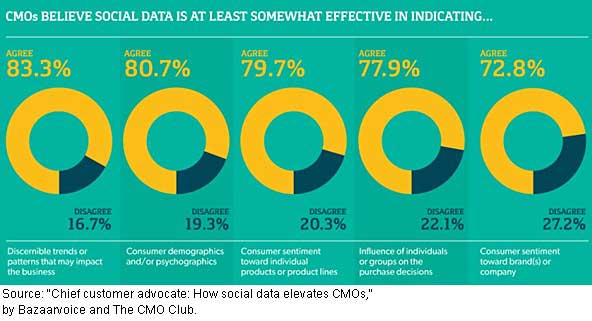
Moreover, CMOs agree that social data* reflects business and consumer trends, and that it's at least somewhat effective in indicating the following:
- Discernible trends that may impact the business: 83.3%
- Consumer demographics and/or psychographics: 80.7%
- Consumer sentiment toward product lines: 79.7%
- Influence of individuals or groups on the purchase decision: 77.9%
- Consumer sentiment toward a brand or company: 72.8%
Below, additional findings from the study titled "Chief customer advocate: How social data elevates CMOs," by Bazaarvoice and The CMO Club.
Social data can also hint at future consumer sentiment and campaign success: 47.3% of CMOs surveyed have used social data to make predictions or forecasts, most commonly to project sales.
Sharing Social Insights
Some 97% of CMOs share insights from social data with other C-level execs at least annually, 67% share such insights at least monthly, and 25% share them at least every week.
In addition, CMOs say their marketing teams share access to social data with other departments or teams, including the following:
- Brand management: 59.6%
- Sales: 36.8%
- Customer experience/Web design: 36.0%
- Product management/development: 35.1%
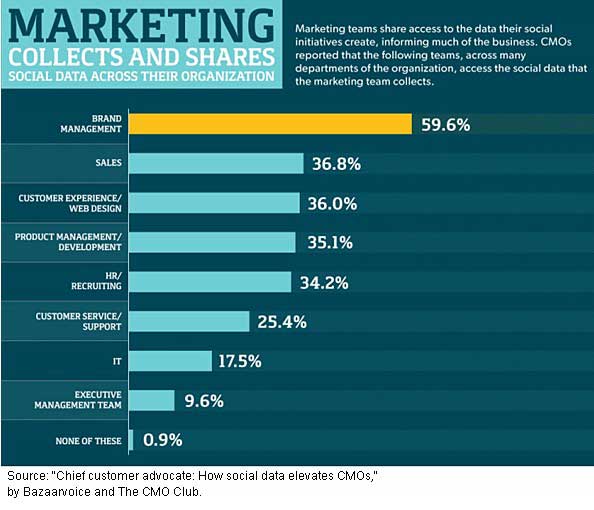
One-quarter (25.4%) of CMOs share social data with customer service teams.
Impact of Social Efforts
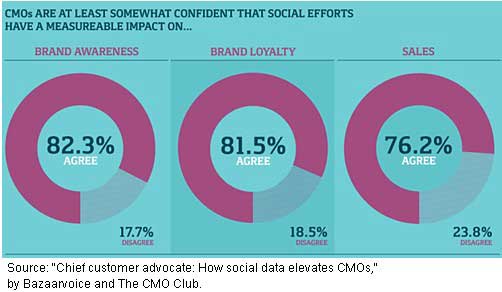
In addition, CMOs say social media efforts are having a measurable impact on sales (76.2%), brand loyalty (81.5%), and brand awareness (82.3%).
*Note: "Social data" refers to any data collected based on consumer use of social. This includes interactions, connections, posts, comments, likes, retweets, and mentions by consumers via Facebook, Twitter, Google+ or other social platforms, as well as demographic, influence, and psychographic data from user profiles, behaviors, and network analyses. Social data also includes user-generated content, including submitting product feedback, asking or answering questions in online forums, or participating in any online community.
About the data: This study is based on a survey of 112 members of The CMO Club, composed entirely of CMOs, fielded online May 18 to June 18, 2012. Some 56.1% of the brands represented have over $1 billion in annual revenue, 36.0% have $100-999 million in annual revenue, and 7.9% have annual revenue of $0-100 million. The brands are headquartered mostly in North America, and operate in the B2C (52.6%) or B2B (38.6%) space, or both (8.8%).