Like many aspects of mobile marketing, location-based social networks (LBSNs) offer interactive marketers the promise of connecting consumers with places and points of sale.
Most marketers, however, should wait to adopt the nascent channel until larger industry players, such as Facebook and Yahoo, offer location-based services at a sufficiently large scale, according to a study by Forrester.
Consumer adoption levels are still low in the fragmented LSBN marketplace. The most popular vendors—Brightkite, foursquare, Gowalla, Loopt, and Whrrl—all boast fast-growing memberships, but many don't publicly reveal their numbers, according to Forrester.
Loopt now reports 4 million users. By contrast, Twitter, still widely considered a niche website, reports 100 million users.
Only 4% of surveyed US online adults have ever used LBSNs on their mobile phones, and just 1% use them more than once a week, Forrester found.
Below, other findings from the Forrester study, Location-Based Social Networks: A Hint of Mobile Engagement Emerges.
Though small in numbers, geolocation users are powerful consumer demographic. They are...
- Young, male, and well-educated—traits typically associated with the early-adopter demographic
- 38% more likely than online adults to say friends and family ask their opinion before making a purchase decision
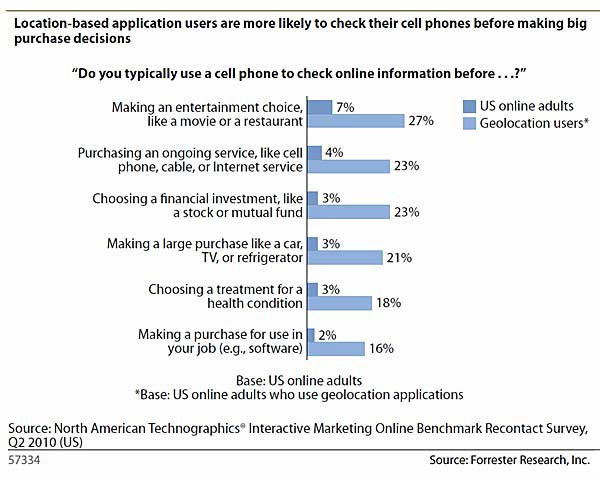
- Roughly 14%-20% more likely to check their cell phones before making big purchases
LBSN users are roughly eight times more likely than online adults to search for information via cell phone about telecom services (23% vs. 4%), financial investment products (23% vs. 3%), large consumer appliances (21% vs. 3%), and business products (16% vs. 2%).
Looking for real, hard data that can help you match social media tools and tactics to your marketing goals? The State of Social Media Marketing, a 240-page original research report from MarketingProfs, gives you the inside scoop on how 5,140 marketing pros are using social media to create winning campaigns, measure ROI, and reach audiences in new and exciting ways.
At this point in the market's development, cutting-edge, male-targeted marketers are best-suited for testing the LBSN waters, especially in areas such as gaming and consumers electronics, and other marketers should wait until adoption rates increase and established players emerge from the fray, according to Forrester.
About the data: Findings are based on a Forrester survey of 42,792 online adults (US and Canada) age 18+ from February to March, 2010.The sample was drawn from members of the TNS Panel.



