Email remains a powerful way to connect with customers and influence their buying decisions: 66% of online Americans say they have made a purchase as a result of an email from a brand, more than three times the percentage of people who have purchased in response to a message delivered via Facebook (20%) or text message (16%), according to a study by Exact Target.
Direct mail is also a key tool for motivating consumers to buy: 65% of surveyed online Americans say they have made a purchase in response to message received via direct mail. By contrast, mobile apps (10%) and social channels such as Twitter (6%) and LinkedIn (4%) are less likely to influence consumers' buying decisions.
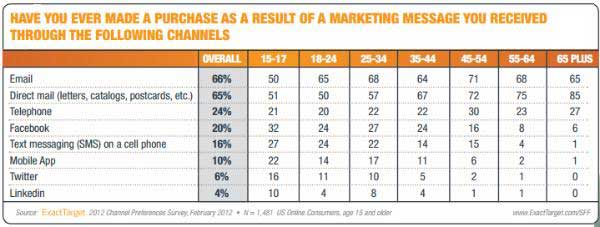
Brand messages via social channels tend to sway younger generations: Teens (age 15-17) are the most likely to be influenced by brand messages delivered via Facebook (32%) and Twitter (16%) when making purchases.
Below, additional findings from Exact Target's 2012 Channel Preferences Survey.

Finding Deals
Even when seeking deals, consumers tend to prefer email (44%), followed by brand websites (43%), search engines (6%) and Facebook (4%).
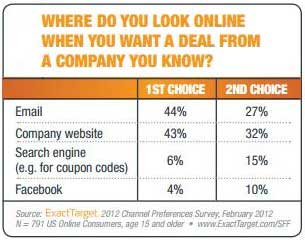
Ask to name their second choice for finding deals, company websites top the list (32%), followed by email (27%), search engines (15%) and Facebook (10%).
Email Favored for Permission-Based Messages
More than three-quarters (77%) of consumers prefer email for permission-based marketing messages. Direct mail is a distant second (9%), followed by text messaging (5%), Facebook (4%), and telephone calls (2%).
Email is preferred even among teens (66%) over all other direct channels for permission-based marketing communications.
Changes in Preferences
Preferences for permission-based communications haven't changed much over the past few years.
In 2008, email was the top permission-based communications channel for 72% of consumers (vs. 77% in 2012).
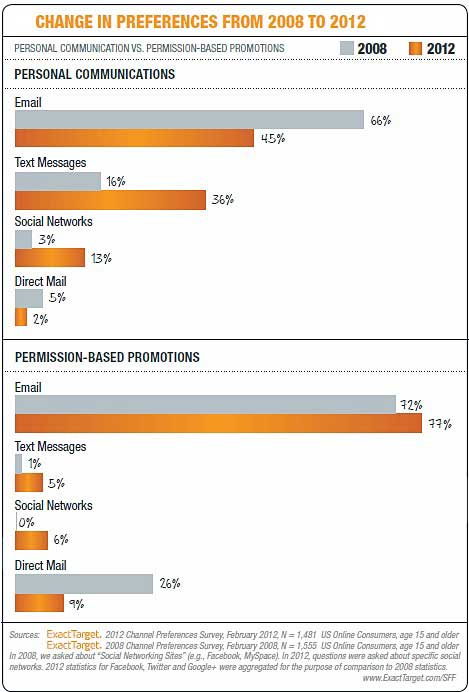
However, consumers' preferences for personal communications have shifted dramatically, in favor of social networks and text messaging:
- 45% now use email for personal communications, down from 66% in 2008.
- 36% use text messaging for such communications, up from 16%.
- 13% use social networks for personal communications, up from 3%.
Sharing Content
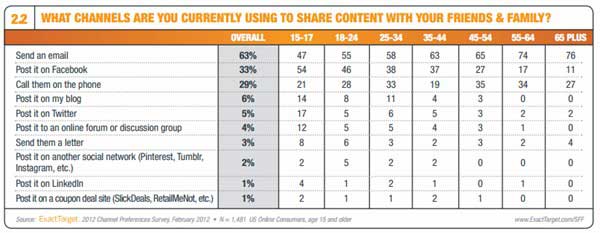
Such shifts in preferences are also reflected in the way people, particularly younger generations, share content with friends and family.
Email is the most popular content sharing channel, even beating Facebook by 30 percentage points (63% vs. 33%). Younger people are less likely than their older counterparts to share content via email; however, teens are the only age segment that shares more content via Facebook than email (54% vs. 47%).
Frequency of Engagement
Email and Facebook are the channels most frequently used among online consumers:
- 96% use email at least weekly.
- 70% use Facebook at least weekly.
- 20% use Twitter at least weekly.
Customer Service Communications
Among online consumers, email is also favored for resolving customer service issues, and for financial and travel alerts:
- When receiving customer service messages, 76% prefer email, whereas 10% prefer direct mail, 4% prefer telephone, and 4% prefer Facebook.
- For financial (banking) alerts, 52% prefer email messages, whereas 18% prefer telephone calls and 15% prefer text messages.
- For travel alerts, 43% prefer email messages, whereas 25% prefer text messages and 18% prefer telephone calls.
About the data: Findings are based on a survey of 1,481 Americans age 15 and over, conducted by Exact Target from January 27 to February 1, 2012.





![The Impact of Contests on Email Leads [Infographic]](http://i.marketingprofs.com/assets/images/daily-data-point/280513-ddp-lg.jpg)


![Social Sharing Boosts Email Results [Infographic]](http://i.marketingprofs.com/assets/images/daily-chirp/social-sharing-boosts-email-results-peek.jpg)


![Big Data: What It Is, Why It's Important [Infographic]](http://i.marketingprofs.com/assets/images/daily-chirp/Big-Data-peek.jpg)


![Nonprofit Benchmarks: Email, Social, Audience, Fundraising [Infographic]](http://i.marketingprofs.com/assets/images/daily-data-point/130409-ddp-lg.jpg)
Rate this
Overall rating
-
-
-
-
-
2 rating(s)Add a Comment
Comments
It seems that age of consumers is also an important criterion affecting the relevance of particular marketing channels. What do you think about the multi-channel strategy effectiveness in relation to people aged 35 - 50?
this survey reinforce the idea that the most useful channels to getting your product out and make sales online are still email marketing and social networking. So the need to build an email list is more than ever crucial to anyone who is willing to make money online.
To Maryna.
After cross analyzing the data in relation with people aged 30-50, i found some interesting results regarding the decision to make a purchase base on the most used channels ( email and facebook) and the use of those two channels for content sharing by this category of online consumers. Roughly 67% of people aged 30-50 purchased via email marketing while 64% of the same category use email for content sharing. the same pattern is observed concerning the use of facebook for content sharing (32%) and the buying decision via the same channel (25%). Thus i can impIy that consumers aged 30-50 are constantly present on those two channels. So i think the multi channel strategy would be really effective, targeting those two channels for the category of consumers you are talking about.
Thanks, Salome! The findings are very impressive, and I believe should challenge the way many companies reach their (potential) customers.
It is extremely helpful to see actual data such as you've presented from the Exact Target study. Thanks for that! It clearly shows us that email remains the preferred B2C marketing channel overall, including travel and tourism marketers. I'm very interested to see how that changes as the social channel matures further and the teen population move into adulthood.
The one concern is when businesses engaging in this type of permission-based marketing forget to follow the CAN-SPAM rules. Working with an established email marketing vendor helps to make sure your business fully complies by making it as simple as one-click to unsubscribe. Telling consumers how often you are going to email and doing what you say is an essential best practice to gain their trust.
However If too many email marketing messages that reach a consumers inbox (not filtered as spam) fail to make it easy and obvious how to unsubscribe, email marketing loses its punch. That is likely what happened to offer based (junk) postal mail as it is time consuming and sometimes nearly impossible to get off mailing lists. I can surely understand the large drop in preference for direct mail over the years.
-Scott
BookingCounts - Get More Bookings - www.BookingCounts.com
As social media marketing is becoming more and more important in internet marketing, I have been worried about for a while that the status of email marketing will decline, or even defeated by SMM.
However, it's good to be here to see so much actual data which shows that although social media is growing fast, email marketing still plays an important part of any complete online marketing strategies. http://www.comm100.com/newsletter/