As more and more marketers and others curate content in their content marketing efforts, they need to be aware of the legalities of using content that isn't theirs.
In some situations, if you use content without the right sort of permission, you may find yourself being sued by the content creator.
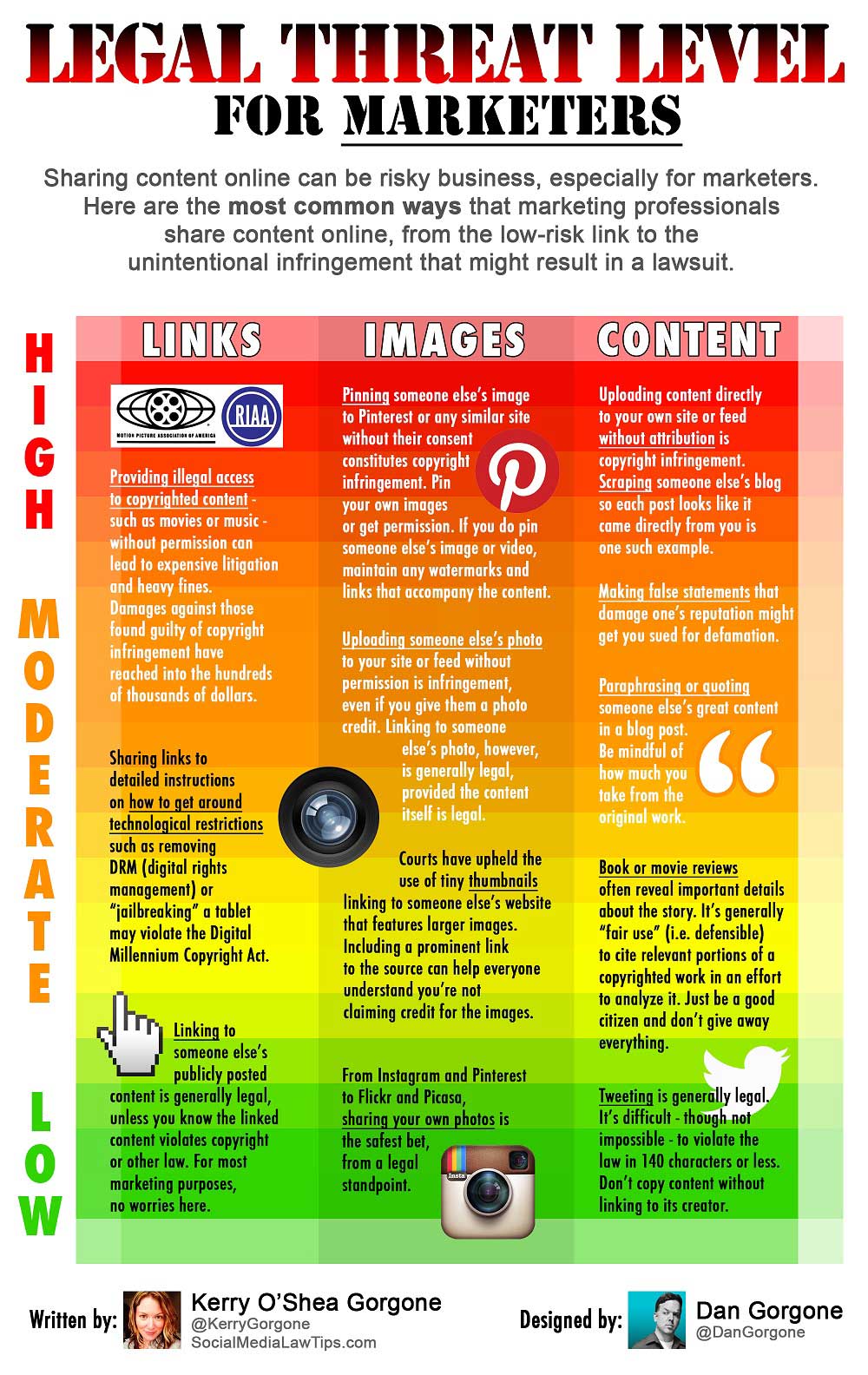
For example, uploading someone else's photo to your site without permission is infringement. That photo credit that you gave them doesn't mean anything; however, a link to the photo is legal (if the content itself is legal).
Quoting people's content is also a popular practice among marketers. But be careful to not quote too much of it, lest you end up plagiarizing rather than paying it homage.
In identifying the most common ways that marketers share content online, Kerry Gorgone and Dan Gorgone ranked that sort of sharing from low-risk to unintentional infringement.

They then created the following infographic depicting the various threat levels:

![Content Marketing Sweetens the Mix [Infographic]](http://i.marketingprofs.com/assets/images/daily-chirp/Content-Marketing-Sweetens-the-Mix-peek.jpg)

![From Nine to Known (Part 2): Nine Tips for Maximizing Your Nine-Minute Brand Actions [Infographic]](http://i.marketingprofs.com/assets/images/articles/lg/060613_clocks_lg.jpg)


![Who Is Winning the Talent War in Social Media? [Infographic]](http://i.marketingprofs.com/assets/images/daily-chirp/Whos-winning-the-talent-war-in-social-media-RecruitLoop-peek.jpg)

![A Master Guide to Product Listing Ads (PLAs) [Infographic]](http://i.marketingprofs.com/assets/images/daily-chirp/A-Master-Guide-to-PLA-peek.jpg)


![Small Businesses Find ROI in Social Media [Infographic]](http://i.marketingprofs.com/assets/images/daily-chirp/roi-in-social-media-peek.jpg)


![Mobile Minute [Video]: Google I/O Isn't Just for Developers](http://i.marketingprofs.com/assets/images/articles/lg/mobile-minute-lg.jpg)

Rate this
Overall rating
-
-
-
-
-
2 rating(s)Add a Comment
Comments
Is it legal to use someone's Tweet or Facebook post added to your company pages and place them your website?
Great graphic! One caution: it's easy to violate the law by tweeting legally restricted information (even just 140 characters) such as protected health information (PHI), a photo of a patient, or information regarding a court case in violation of a gag order. There's more than copyright to worry about.
What about the 'Share' button on Facebook? The purpose of it is to Share others content. It automatically gives credit and links the owner.
However, I have seen some people get offended over another user 'Sharing' their photo or video. Is their any legal issues with that?
@Betsy, I wouldn't recommend it. It's one thing to have a live feed of your own social media posts, or even one that displays every mention of your brand (though that's risky from a reputation standpoint). Selecting certain posts or tweets, however, could violate the copyright of the person who wrote them.
Great point, @Donna! To be sure, sharing restricted information could subject the poster to liability, even if they do it in Twitter-speak.
@Casey, It really depends on what's depicted in the image or stated in the post. If there's some reason (apart from ownership) that sharing it would be illegal (e.g. it depicts minors in an inappropriate way or the post contains false statements damaging to someone else's reputation), you could run into a problem.
The poster's rights also depend on who originally created the content. If it's their own original work, they could theoretically allege copyright if you share it (although, as you point out, why put it online in the first instance if not to have it shared?) Every Facebook user can adjust his or her privacy settings to prevent sharing, so awareness ought to prevent some issues.
It's still possible that a legal claim (such as "invasion of privacy," for instance) could arise from sharing content that's displayed only to "Friends," but I'd say that the poster has implicitly consented to the sharing of any information he or she posts publicly. Of course, it really depends on the specific facts of any particular case.
Wonderful graphic, thank you Kerry and Dan.
@Casey, I think when they post something not as a post on FB but their blog or somewhere similar and there is a Share button on the website, it's generally thought of as consent to "share" the content (as long as the copyright is still intact). I think it's more difficult when someone posts it directly on FB, mainly because he or she might have restricted the post to only be seen by 'friends' or 'friends of friends' and not made it public. Sharing it then could be seen as infringement. If in doubt, ask them.