Though more than nine in ten Facebook users (93%) click on a Facebook “like” button at least once a month, their motivations for doing so vary considerably by age and context, according to a new study by ExactTarget and CoTweet.
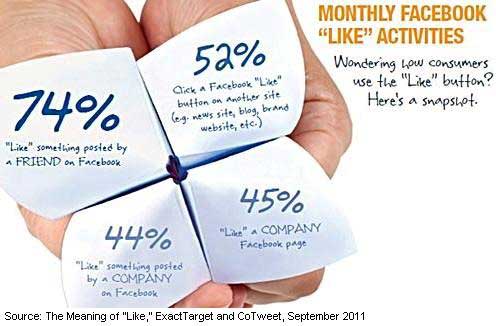
Nearly two-thirds of Facebook users surveyed say they "like" at least one brand on Facebook; among them, the top like-related activities performed at least monthly include the following:
- Like an item posted by a friend on Facebook: 74%
- Social bookmarking (clicking the "like" button from an external website): 52%
- Like a brand's Facebook page: 45%
- Like an item posted by a brand on Facebook: 44%
Below, additional findings from the titled "The Meaning of Like," the latest in ExactTarget's Subscribers, Fans and Followers research series.
"Like" Does Not Necessarily Mean "Permission"
Nearly two in five Facebook users who like brands (39%) say the act of "liking" a brand should never be interpreted as permission to post marketing messages that appear in a user's news feed, whereas 15% say "liking" a company's Facebook page should "always" be interpreted as permission to do so.
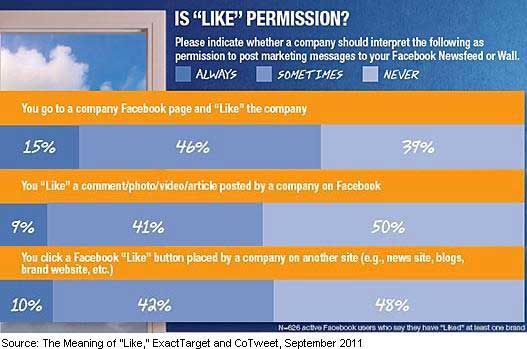
Similarly, 48% of Facebook fans say the act of bookmarking a brand via the "like" button from another site (e.g., news site, blogs, brand website, etc.) should never be interpreted as permission to post marketing messages in a user's news feed; 42% say that action can sometimes be interpreted as permission and 10% say it should never be interpreted as such.
What Consumers Expect in Return
When liking a brand, most Facebook users expect to receive access to excusive offers and content (58%) and discounts and deals (58%), while 47% expect to receive updates about the brand in their newsfeed.
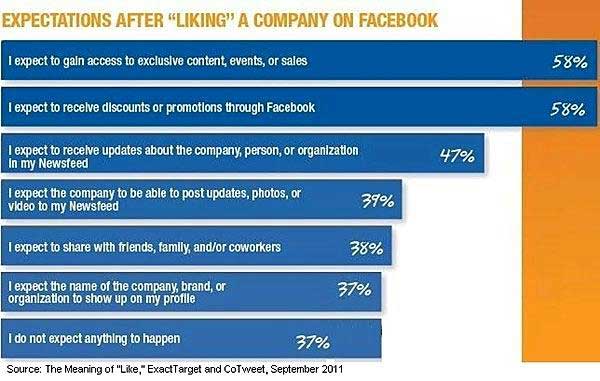
More than one-third of Facebook fans (37%) expect the brand's name to appear in their profile, while an equal proportion (37%) expects nothing whatsoever.
Expectations Vary by Age
Among Facebook fans, expectations for brand interaction tend to vary by age:
- Facebook users age 18-26 have the lowest expectations of receiving something in exchange for their "like" endorsement. Such younger consumers tend to use like for self-expression and public endorsement of a brand.
- Those age 27-34 are more likely to expect something of value in exchange for their like—most commonly, the opportunity to receive updates on new products, promotions, and savings.
- Those age 35-51 have the highest expectations. Such fans want something in return for liking a company and something relevant and valuable (e.g., information or discounts).
- Those age 35-51 are most likely to "unlike" a brand when it doesn't meet expectations.
Sharing Public Profile Information
Overall, 56% of Facebook users say marketers should not access even their public profile information after they like a brand Facebook.
However, age plays a role how people view the sharing of their profile information:
- Facebook users age 25-34 are most comfortable with allowing marketers access to public profile information. Even so, such consumers are largely against the practice, with only 24% saying marketers should access their information, compared with 47% who think marketers should not; the remaining 29% are undecided.
- Facebook users age 45+ are strenuously opposed, with 70% saying marketers should not access their public profile information, and only 10% raising no objection.
Other key findings:
- Facebook users in the US say they like 14 companies or brands, on average.
- People who like more brands (11+) are more likely to be motivated by rewards such as coupons or exclusive deals in exchange for their "like" endorsement.
- Among Facebook users who have liked at least one brand, 31% have avoided liking more brands in order to avoid pushing content into their friends' newsfeeds.
About the data: Findings are based on a series of focus groups, interviews and surveys among roughly 1,000 users of Facebook, conducted in May and June 2011. "The Meaning of Like" is the tenth report in ExactTarget's Subscribers, Fans & Followers research series.



