Content has always been king, but now the kingdom is much larger and more powerful than ever. The importance of content in marketing has skyrocketed. Online media channels—possibly serving as the only source of information leading up to the purchase—allow your target audience to self-educate and become more-informed buyers. As a result, your audience is now less reliant on sales-oriented interactions with your company.
In this environment, content marketing can be extremely influential in driving high return on investment (ROI). But its greatest impacts can easily be missed if unmeasured and unmanaged.
Research has shown that content-oriented marketing initiatives that engage and educate are considered most effective at driving "high value leads most likely to convert to sales" (2010 Lenskold Group / emedia Lead Generation Marketing ROI study).
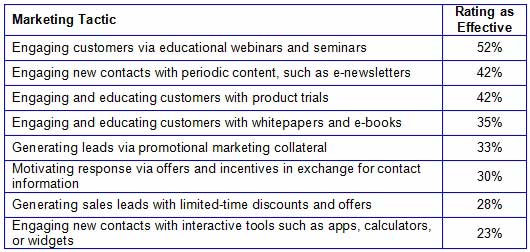
Though the impact of content marketing is equally important to B2C companies selling through retailers or direct, this research with B2B lead-generation marketers finds that ratings of effectiveness (Top 2 scores on a five-point scale) favor content marketing:
We'll now go through the three steps you can take to achieve higher ROI:
- Prioritize the right metrics for content marketing
- Manage key decisions for content marketing
- Improve performance and ROI
1. Prioritize the right metrics for content marketing
Think about the key strengths of content marketing and how they ultimately contribute to incremental sales, revenues, and profits. Content helps to shape buyers' needs, provide deeper knowledge of products and services, and support customers in gaining greater value from the relationship.
Content marketing not only communicates information but can be valuable thought leadership that offers a positive customer experience and differentiator to engage, win, and retain customers.
Where does content marketing contribution show up from a financial perspective? The following three primary metrics, which indicate the contribution from better-educated and engaged contacts, must be measured and managed:
- Higher sales-conversion rates indicate those more likely to buy.
- Higher customer value indicates those more likely to upgrade to higher-tier products/services; buy more, and more often (greater share of customer); and engage in more profitable and loyal relationships.
- Faster conversion velocity indicates shorter sales cycles, which tend to both increase conversion rates and decrease the resource cost of internal sales staff.
Without insight into these profit-driver metrics, marketers tend to rely on quantities of short-term behaviors: counting engagement, views, or leads. That is a big disconnect between content strengths and measured impact.
Engagement can be especially misleading. If you count webinar attendees or whitepaper downloads, you are actually measuring not the impact of the content but the impact of the promotional message driving visitors to download, register, or attend.
The impact of the content is reflected in the behaviors and outcomes that follow. Of the three metrics listed, increasing the average customer value will most often be a major outcome and a major indicator of good content.
2. Manage key marketing decisions for content marketing
The metrics we choose ultimately influence our marketing decisions, which is why we want to move from short-term response-oriented metrics to business outcome-oriented metrics. Let's look at the most important strategic and tactical decisions related to content marketing to understand what measurement insights are most important.
Choose and prioritize content topics
- Track and analyze which topics and messages are most effective at stimulating conversions, customer value, and purchase velocity
- Identify topics that are less effective, and take steps to refine or replace the content
Optimize the marketing mix
- Understand the influence of the delivery channel (e.g., webinar, whitepaper, e-book) and content types (e.g., introductory vs. complex, entertaining vs. serious, prospects vs. customers) on outcomes to better match the two
- Identify the most influential and least influential tactics, and concentrate limited budgets on more-effective drivers
Target the right segments
- Match outbound targeting to segments that have high-conversion and high-profit potential, and use content marketing to boost these beyond average values
- To attract better segments, use content topics and messaging for targeting
Map your content strategy to funnel segments
- Identify the content most likely to influence buyers in specific funnel stages, such as exploratory information collection, category education, defining needs, or comparison-shopping
- Analyze historical patterns to determine the ideal progression of content consumption, with the intent of guiding potential buyers to the next steps (e.g., from webinar to whitepaper, from video viewing to e-book) and maximizing key metric outcomes
- Determine the content best suited for nurturing unqualified contacts, in an effort to increase value potential while maintaining interest
Measuring the right metrics will improve the managing of these key marketing decisions.
3. Improve performance and ROI
Making significant improvements in marketing effectiveness comes not just from ongoing tracking of current marketing but also by constantly testing and comparing alternatives. Targeting, content frequency, and integration efforts are best assessed through structured testing.
The challenge with testing is that you are dependent on short-term outcomes for timely decision support, and we've just established that measurements and decisions must be based on the business outcomes of sales conversion and customer value. What's required, then, is to use projected outcomes to forecast the expected financial contribution (see "Using Strategic Measurements to Boost Effectiveness" for three projection methodologies that are applicable for this purpose). Some indicator metrics that can be captured following the content exposure, such as purchase intention or competitive preference, may show strong enough correlations to actual behavior to serve as a short-term proxy of relative contribution.
Finally, strategies and tactics for content marketing are assessed using ROI to ensure the financial contribution exceeds the marketing expense and meets financial objectives. Again, measurements based only on quantities engaged will work against richer, more expensive content delivery if there is no accounting for incremental customer value and conversion rates.
Our goal isn't to create overwhelming, complex measurements but to selectively pursue more insightful measurements that help drive decisions that reflect the true benefits of your content marketing.