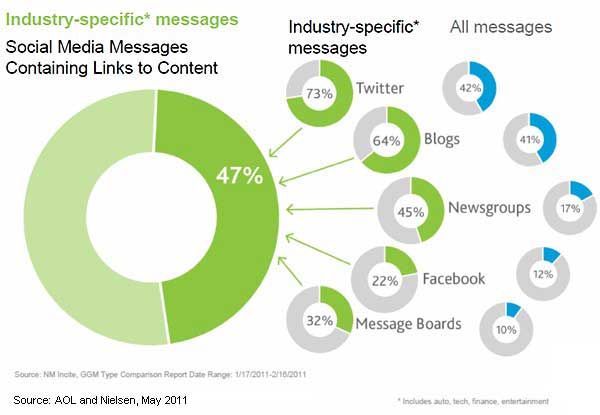
Content is the fuel of social interaction on the Web: Nearly one-quarter (23%) of all social media messages and one-half (47%) of industry-specific social messages contain links to content, according to a new study by AOL and Nielsen.
The amount of content shared via social media varies by channel:
- 42% of all Twitter posts contain content-sharing links; 73% of Twitter posts related to a specific industry (auto, tech, finance, and entertainment) contain sharing links.
- 41% of all blog posts contain content-sharing links; 64% of industry-specific blog posts contain such links.
- 12% of all Facebook posts contain content content-sharing links; 22% of industry-specific Facebook posts contain such links.
Below, other findings from the from AOL report, published in partnership with Nielsen, based on data from Nielsen's Incite Social Media monitoring tools and a survey of 1,000 online consumers.
Roughly 27 million pieces of digital content are shared on any given day in the US.
Among other key content-related findings:
- 53% of time spent on the Internet is directly attributable to content consumption.
- Brands play a key role: 60% of all content-sharing messages specifically mention a brand or product name.
- Email is the primary content-sharing tool among surveyed consumers (66%), followed social media (28%) and instant messaging (4%).
Sharing Trusted Information
Consumers say trust and a desire to help people are key factors in deciding which content to share:
- 38% share information from people they trust.
- 36% share important information that helps others (e.g., traffic reports, how-to, community information).
- 35% share items about popular culture.
- 32% share information pertaining to common interests.
Most People Share via Multiple Platforms
Nearly all (99%) people who share content via social media also use email to share content:
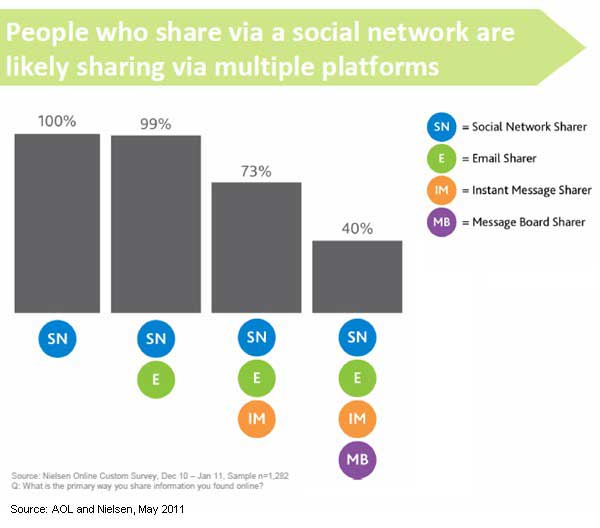
Some 40% of social media sharers also use email, instant messaging, and message boards to share content.
Formats of Shared Content
Digital content is shared in primarily two ways:
- Link-back media: 60% of content shared on social platforms includes a link (URL) to published content on an external site.
- Pass-along media: 36% of content shared on social platforms is embedded.
- Link-back non-media: 4% of content shared includes a link (URL) to a brand or corporate website.
Looking for great digital marketing data? MarketingProfs reviewed hundreds of research sources to create our most recent Digital Marketing Factbook (May 2010), a 296-page compilation of data and 254 charts, covering email marketing, social media, search engine marketing, e-commerce, and mobile marketing. Also check out The State of Social Media Marketing, a 240-page original research report from MarketingProfs.
Context of Shared Content, by Industry
Across four key industries, most shared content is informational—consisting of general news, announcements, product information, and how-to exchanges.
Even so, tech-related informational content is most likely to be shared (74%), as is commentary and opinion related to the financial sector (28%).
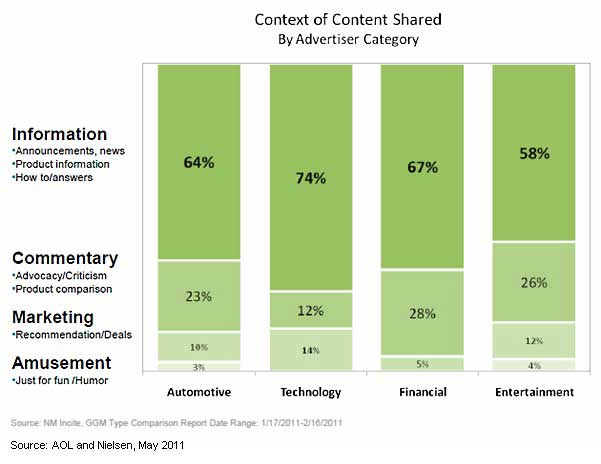
Content containing information about deals is most likely shared in tech (14%) and entertainment (12%).
About the study: Findings are based on Nielsen's NM Incite Social Media Monitoring tools, Online Behavior Panel and Attitudinal analysis, tracking more than 10,000 social media messages; and on a survey of more than 1,000 Nielsen Online panel members for 10 consecutive days, December 14-23, 2010.