Social media still trails traditional marketing channels such as email in driving traffic to retail websites; however, customers who visit top retail sites because of a social media interaction are highly likely to purchase, according to a study by Foresee Results.
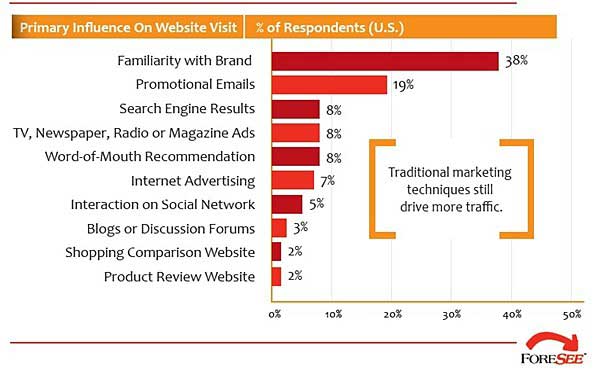
Only 5% of online shoppers surveyed say they are primarily influenced by social media to visit a top retailer's website. Most (38%) cite existing familiarity with a brand, followed by promotional emails (19%) and search engine results (8%).
Below, other findings from The ForeSee Results Report on Social Media Marketing.
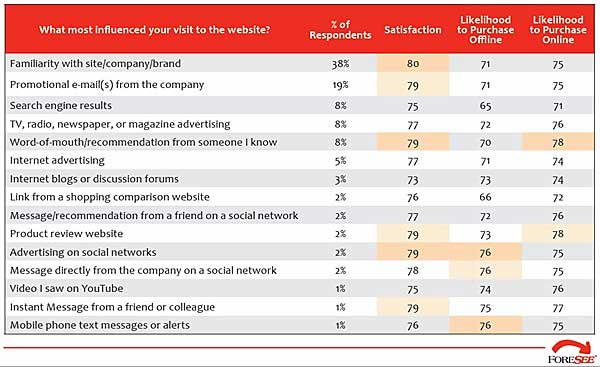
When considering the quality of customer visits to brands' sites, however—particularly in likelihood to purchase and overall satisfaction—the findings tell a more interesting story. Broken out by Web traffic referral sources, consumers rate their experiences on retail sites (using a 100-point-scale):
- The most satisfied site visitors come to sites because of previous familiarity with a brand (80), promotional emails (79), word-of-mouth (79), product review websites (79), ads on social networks (79), and instant messages from friends or colleagues (79).
- Consumers highly likely to buy offline are those whose site visits are most influenced by ads on social networks (76), messages from brands via social networks (76), and mobile text messages or alerts (75).
- Consumers highly likely to buy online arrive because of product review websites (78), word-of-mouth recommendations (78), or instant messages from a friends or colleagues (77).
Traditional Channels Valued
Still, most (64%) online shoppers want to "hear from retailers" via promotional emails, followed by postal mail (25%) and brands' websites (21%). Only 8% prefer to hear from brands via social media and 5% from mobile text messages or alerts.
Among the 8% who prefer to hear from brands via social media, 40% cite Facebook as their top social site, followed by Twitter (4%). YouTube (2%), LinkedIn (2%), and MySpace (2%) tie for third place.
Looking for real, hard data that can help you match social media tools and tactics to your marketing goals? The State of Social Media Marketing, a 240-page original research report from MarketingProfs, gives you the inside scoop on how 5,140 marketing pros are using social media to create winning campaigns, measure ROI, and reach audiences in new and exciting ways.
Facebook Most Popular Among Shoppers
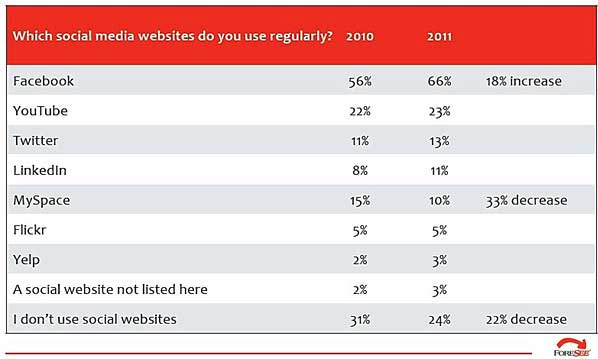
Though social media isn't a huge driver of sales and traffic yet, there's still upward momentum in adoption. Asked which social networking site they prefer, online shoppers cite the following:
- Facebook is most popular: 66% say they visit Facebook regularly, up 18% from the 56% who said they did so in a year earlier.
- 23% say they visit YouTube regularly, up from 22%.
- 13% say they visit Twitter regularly, up from 11%.
- 10% say they visit MySpace regularly, down 33% from the 15% who said so a year earlier.
Interestingly, consumers are more satisfied with retailers’ presence on Facebook than they are with Facebook itself: Online shoppers give Facebook a satisfaction score of 64, while they rate the Top-40 retailer's presence on Facebook an 80, just two points above the average score for retailers' own websites (78).
About the study: ForeSee Results surveyed 10,000 visitors to the top 40 e-retailer sites (per Internet Retailer's 2010 Top 500 Guide) from Nov. 29 to Dec. 15, 2010. The E-tail Satisfaction Indices are based on methodology of the American Customer Satisfaction Index (ACSI).